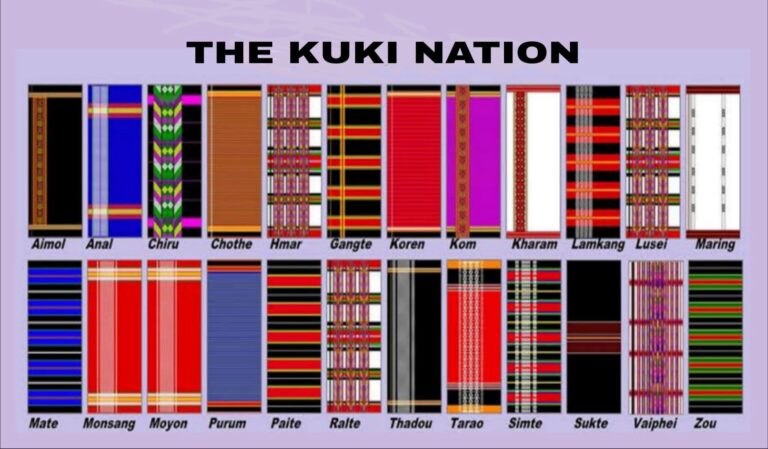
Kuki is the name of our nation, and Kukiland is the name of our land. The Kuki nation is a collective of kindred tribal communities spread across the Northeast of India, Bangladesh, and Myanmar. This includes the Bawn, Chin, Hmar, Mizo, Gangte, Chorei, Ranglong, Vaiphei, Simte, Zou, Kom, Aimol, Paite, Koireng, Maring, Anal, Chiru, and other sub-tribes who share common ancestry, language roots, customs, and chieftainship systems. Historical accounts record the Kuki presence from the Chittagong Hill Tracts in present-day Bangladesh, through Mizoram, Tripura, Assam, and Manipur, to the Chin Hills and Sagaing Region of Western Myanmar. British ethnographers and administrators such as C.A. Soppitt, J. Shakespear, and G.A. Grierson documented these groups under the nomenclature “Kuki-Chin” in the Linguistic Survey of India and various district gazetteers, noting their distinct socio-political organization under hereditary chiefs.
The Kuki nation’s history predates British colonial rule in India by centuries. Oral traditions and genealogies trace the origin of the Kuki people to Khul, a mythical cave in the Chin Hills, with migrations recorded in the chronicles of neighboring kingdoms. The Kuki nation’s recorded presence extends to the 6th–7th centuries CE. Ancient texts including the Mahabharata and the Tripura Rajmala reference the Kirata and Kuki chiefs in the eastern hills, recording tribute, alliances, and conflicts with valley kingdoms. Chinese Tang Dynasty annals from the same period describe hill tribes west of Burma as “Chu-ke” and “Chou,” trading with Pyu city-states. By the 7th century, Sanskrit inscriptions of the Kamarupa kingdom under Bhaskaravarman also mention Kirata chiefs in the eastern hills, whom scholars like S.K. Chatterji identify with ancestral Kuki groups. These sources place Kuki polity and territory firmly in the first millennium.* From the 16th century onward, Ahom Buranjis and Manipur royal chronicles such as the Cheitharol Kumbaba record Kuki chiefs and their territories, alliances, and conflicts with valley kingdoms. In 1904, the British Indian Government demarcated the “Kuki independent hill country” in administrative correspondence, and maps of the period marked large tracts between the Naga Hills and Lushai Hills as “Kukiland.” The Imperial Gazetteer of India and Assam District Gazetteers further describe Kuki country as being administered by chiefs independent of the plains, with whom the British concluded treaties and punitive expeditions.
Our forefathers fought valiantly in defense of our homeland against external encroachment and colonial expansion. The Kuki War of 1860–1861, also recorded as the Great Kuki Invasion, saw confederated Kuki chiefs resist the extension of British administration into the hill tracts south of Cachar and Sylhet. Chiefs such as Vonpilal, Kanhal, and others mobilized thousands of warriors, compelling the colonial government to negotiate and recognize Kuki control over their territory. Later, during the Anglo-Kuki War of 1917–1919, Kuki chiefs across Manipur, Naga Hills, and North Cachar Hills united under leaders like Chengjapao Doungel, Tintong Haokip, and Khotinthang Sitlhou. They rejected the British Labour Corps recruitment drive, viewing it as a violation of their sovereignty. The war spread across more than 6,000 square miles, and colonial dispatches described it as the most formidable hill resistance in the Northeast. Though ultimately suppressed by superior firepower, the conflict forced the British to reassess their hill policy and reaffirm the authority of Kuki chiefs through indirect rule. These conflicts underscore our forefathers’ organized political structure, military capacity, and enduring commitment to sovereignty and self-determination.
The term “Zo” specifically refers to the Mizo community, and the name “Mizo” was formed during the 1960s under the leadership of (Late) Laldenga, the first Chief Minister of Mizoram state and leader of the Mizo National Front. Furthermore, “Zo” bears no historical or etymological connection to the Chinese term “Zhou.” Another newly formed nomenclature, “Zomi,” emerged during the 1990s; they are mostly from Myanmar and are termed illegal immigrants.
The Kuki nation possesses a well-documented history and territorial claim. In India, the Kuki tribes are recognized as Scheduled Tribes under the Constitution of India and are listed in the Scheduled Tribes orders for Assam, Manipur, Mizoram, Nagaland, and Tripura. Historical records, including British colonial documents and gazetteers, reference the Kuki country and Kuki chiefs’ administration of hill areas. The Government of India’s census records and official tribe lists have consistently enumerated Kuki sub-tribes since Independence, affirming their distinct identity and historical presence in the region.
Declaration:
Therefore, the Kuki identity is not a recent political construct, nor is Kukiland an imagined geography. It is a nation with blood, borders, and battles recorded in history. The chiefs who signed treaties, the warriors who resisted empires, and the generations who preserved our customs did so under the name Kuki, on the land known as Kukiland. To deny this is to erase gazetteers, chronicles, and graves. We, the descendants, inherit not only the name but the duty to defend it. Kuki is our nation. Kukiland is our land. And history is our witness.