Moreh: At least 33 people were killed and 36 others injured on Monday after Myanmar’s military carried out an airstrike on a crowded market area in Kyauktaw township in northern Rakhine State, according to rescue officials and the Arakan Army which controls the area. The attack, which struck near the region’s main wholesale market and an adjacent bridge at around noon local time, is being described as one of the most severe aerial assaults in Rakhine since the escalation of conflict in late 2023.
The Arakan Army said in a statement that a military fighter jet dropped two bombs on the market area, hitting vendors, shoppers and pedestrians who had gathered for daily trade. The group said the casualties included market sellers and civilians passing over the bridge, and warned that the death toll could rise further as several of the injured were in critical condition and rescue operations were still underway.
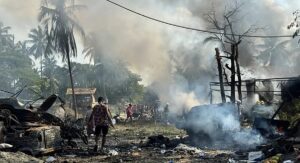
Wai Hun Aung, a senior rescue official operating in Rakhine, confirmed the figures to international news agencies. He said the market in Kyauktaw serves as the primary wholesale hub for the northern part of the state, drawing traders and buyers from across Rakhine every day. Because the strike occurred during peak trading hours at around 12:00 pm (0530 GMT), the number of casualties was high. Images and videos shared on social media after the attack showed thick smoke, burning structures, charred vehicles and a section of the nearby bridge heavily damaged.
Myanmar’s military junta did not immediately issue a response to the latest strike. In previous incidents, the military has maintained that it only targets what it calls legitimate military objectives and has accused resistance forces of using civilian areas for cover, labeling them as terrorist organizations. Human rights groups and local residents have repeatedly disputed those claims, saying airstrikes have increasingly hit civilian infrastructure including markets, schools and hospitals.
Monday’s attack is the latest in a series of intensified air operations by the military against territories held by ethnic armed organisations and pro-democracy resistance forces. Since seizing power in a coup in February 2021 that ousted the elected government led by Aung San Suu Kyi, the military has faced a nationwide armed uprising that has gradually evolved into a full-scale civil war involving multiple ethnic armies and People’s Defence Forces aligned with the exiled National Unity Government.
In Rakhine, the conflict has taken a distinct turn. The Arakan Army, one of Myanmar’s most well-trained and well-armed ethnic armed groups fighting for self-determination for the Rakhine ethnic population, launched a major offensive in November 2023. Since then, it has captured significant territory, including strategic military headquarters and 14 out of the state’s 17 townships, effectively taking control of most of northern and central Rakhine. The military has responded with airstrikes, artillery shelling and a severe blockade of trade routes into the state.
The blockade has had devastating humanitarian consequences. With overland and waterway trade routes restricted by the junta for months, food shortages, price hikes and shortages of essential medicines have been reported across Rakhine. Aid agencies say access to the state remains extremely limited. The latest attack on the main market in Kyauktaw is expected to further worsen food security and disrupt the already fragile local supply chain that thousands of families depend on.
This is not the first time a civilian-heavy location in Rakhine has been targeted from the air. In December last year, a military airstrike on a hospital in Mrauk-U township killed at least 33 people and wounded 70 others, triggering condemnation from the United Nations and international rights groups. Local monitoring groups say airstrikes across Myanmar have increased sharply in 2025 and 2026 as the military has lost ground in ground battles and has increasingly relied on air power and, more recently, drones.
According to data from the United Nations, nearly half a million people are currently displaced in Rakhine alone as a result of fighting between the military and the Arakan Army. Across Myanmar, millions have been displaced internally and across borders since 2021. The UN Human Rights Office said in August that the human rights situation in the country has fallen “to a new low”, pointing to systematic violations, brutal abuses against the Rohingya minority who remain in Rakhine, and the devastating impact of illicit economic activities including unregulated rare earth mining in the north.
The broader civil war continues to exact a heavy toll. According to the Armed Conflict Location and Event Data Project (ACLED), more than 100,000 people have been killed since the conflict began after the coup. Both sides are now increasingly using unmanned aerial vehicles for surveillance and attacks, marking a new phase in the war. The Arakan Army has also deployed drones to target military positions, while the junta has used them for reconnaissance before airstrikes.
Politically, the military government has sought to project a sense of normalcy and legitimacy. In April this year, former military chief Min Aung Hlaing was elected President by a parliament stacked with military-backed lawmakers, formalising his hold on power after five years of direct army rule. The move was dismissed by opposition groups and Western governments as an attempt to legitimise military rule, even as the junta promised to hold elections which critics say will not be free or fair under current conditions.
International reaction to the Kyauktaw airstrike was still emerging late on Monday. Humanitarian organisations operating near the Myanmar border said they were trying to verify details and assist the wounded, but access challenges remained severe. Regional diplomats have in recent months called for a cessation of attacks on civilians and for unhindered humanitarian access, including Malaysia’s recent offer to facilitate dialogue on Rohingya repatriation, but there has been little progress on a broader peace process as fighting intensifies in Rakhine, Chin, Kachin and Sagaing regions.