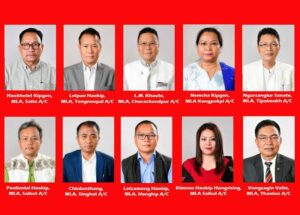
The 10 Kuki MLAs elected from the hill districts can no longer justify their seats in the Manipur Legislative Assembly. After three years of displacement, targeted violence, and a complete breakdown of trust between the Kuki and Meitei communities, their presence in the House has become symbolic of a constitutional arrangement that no longer functions. If the demand for separate administration is to be taken seriously by Delhi and the world, the MLAs must resign and return their mandate to the people who elected them.
An assembly seat implies participation in governance. Yet since May 2023, Kuki representatives have not been able to set foot in Imphal without risk to their lives. They have not attended sessions, have no role in budget decisions, and cannot secure protection or relief for their community through the state machinery. To draw salaries and retain titles while their voters live in camps for the third year is a contradiction that weakens the moral case for political separation. Resignation ends that contradiction and signals that the social contract with the Manipur state has collapsed.
The human and material cost over three years makes legislative participation indefensible. Community records and civil society estimates place the death toll among Kukis at over 250, including women and children. Thousands of houses, churches, schools, and clinics across Kangpokpi, Churachandpur, Tengnoupal, and Chandel have been reduced to ashes. The estimated loss of Kuki property runs into thousands of crores — homes looted and burned, farmland destroyed, businesses gutted, and livestock killed. Families who fled in May 2023 remain in relief camps, unable to return. These are not statistics; they are evidence that the state has failed to protect life and property.
The violence has been marked by acts of extreme brutality. Cases of targeted killing, rape, and the public parading of women have been reported from the initial weeks of the conflict. Children have been among those burned alive, and most of the Kuki civilians killed by Meitei mobs were beheaded and mutilated when villages were attacked. The May 13 killing of three Kuki pastors returning from a church council underscored that even clergy engaged in peace efforts are not spared. Legislative privilege did not prevent these atrocities, nor has it secured a single impartial investigation in three years. When an assembly cannot guarantee the right to life for the families of its own members, membership itself becomes complicity in a failed system.
The argument that holding seats keeps a “channel open” no longer holds. The channel has been closed by mobs, by administrative orders, and by the silence of the state executive when Kuki villages burned. This applies with greater force to Nemcha Kipgen, who continues to hold the post of Deputy Chief Minister while her community remains displaced and unprotected. Retaining that post lends legitimacy to a government that has failed the hill community of the Kuki people. To honour the mandate of her community, Nemcha Kipgen must step down and join a collective resignation.
Resignation is not an abdication of responsibility. It is a realignment of responsibility toward the people. The MLAs were elected to protect land, rights, and dignity. That mandate can now only be exercised by building a parallel political authority that answers to the village councils, church bodies, and civil society groups already running daily life in the hills. A joint resignation would create the legal and political vacuum needed to compel the Centre to appoint an interim administrative mechanism, the first practical step toward separate administration.
History offers precedent. When constitutional pathways are blocked, elected leaders have resigned en masse to force a political settlement — from Mizoram in 1966 to Jharkhand in the 1990s. In each case, Delhi responded only when state legislatures could no longer claim to represent the aggrieved region. The Kuki MLAs today face the same choice: remain as nominal members of a House that cannot hear them, or step out and constitute a People’s Representative Council that derives authority directly from the grassroots.
The demand for separate administration will not be granted on petitions and memoranda alone. Three years of waiting have proven that. It requires political action that imposes a cost on the status quo. A collective resignation does that. It tells the Union government that the current state of Manipur has lost legitimacy in the hills, and that governance must be rebuilt from the ground up. The MLAs must choose: keep their seats and lose their people, or give up their seats and lead their people.(Views expressed are personal)