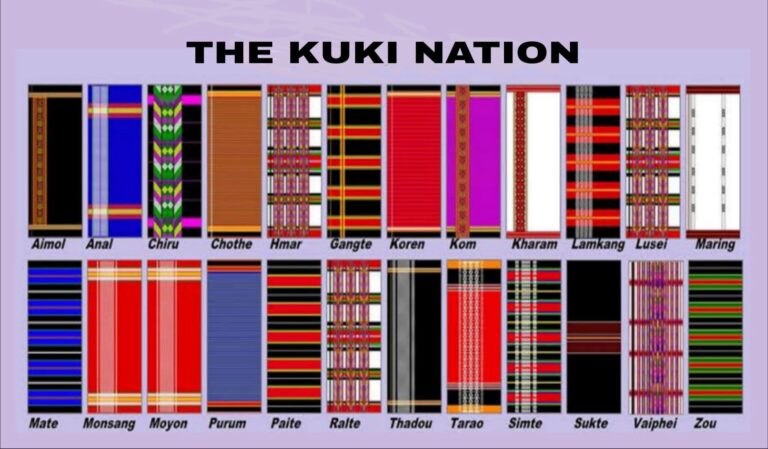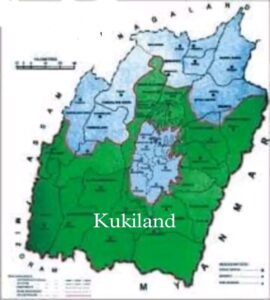
The demand for a separate State or Union Territory for the Kuki community fails on constitutional, administrative, and political grounds.
Ignoring Recognized ST Identity Under Article 342
The Scheduled Tribe status granted in India is specifically under the name “Kuki”. This is the only nomenclature recognized in the Constitution of India under Article 342 for political and administrative purposes. Article 342(1) empowers the President to specify tribes or tribal communities which shall be deemed to be Scheduled Tribes in relation to a State or Union Territory, and Article 342(2) states that Parliament may by law include or exclude from the list. The current list for Manipur, under The Constitution (Scheduled Tribes) Order, 1950, lists “Kuki” as a recognized ST.
Yet, current political demands are being raised not as “Kuki”, but under newer umbrella terms like “Zo”, “Zomi”, and “Kuki-Zo”. These terms appear in no Presidential Order, no Act of Parliament, and no Gazette notification. They have no constitutional or legal recognition, and no political right attached to them in India. Under Article 366(25), “Scheduled Tribes” means such tribes or tribal communities as are deemed under Article 342. Demands made outside that framework dilute the legal basis of the claim and cannot be entertained by Parliament for the purpose of Article 3.
Shifting Political Identity Undermines Legal Standing
A political demand for territorial reorganization must be consistent with the identity that holds legal standing. By shifting from “Kuki” to fluid, pan-ethnic labels, the movement separates itself from the very ST framework that grants protections, reservations, and special provisions under Part XVI of the Constitution.
Articles 2 and 3 of the Constitution vest Parliament with the power to admit new States, form new States, and alter areas, boundaries or names of existing States. Historically, Parliament has exercised this power on linguistic basis under the States Reorganisation Act, 1956, or on administrative and ethnic grounds as seen in the creation of Nagaland in 1963, Mizoram in 1987, and Telangana in 2014. In each case, the demand came from a clearly defined, constitutionally recognized community with settled domicile. Parliament does not create States for constructed collective terms with no legislative history, no census enumeration, and no entry in the ST list.
Citizenship and Illegal Immigration Question
The question of illegal immigration from Myanmar remains a core objection raised by both state and central authorities. Article 5 to Article 11 of the Constitution define citizenship at the commencement of the Constitution and empower Parliament to regulate it through law, including the Citizenship Act, 1955. Section 3 of that Act lays down citizenship by birth, descent, registration, and naturalization.
Statehood and UT demands require a settled, verifiable population base with Indian citizenship. The Foreigners Act, 1946 defines a foreigner as a person who is not a citizen of India, and the Passport (Entry into India) Act, 1920 regulates lawful entry. The Registration of Foreigners Act, 1939 and The Citizenship (Registration of Citizens and Issue of National Identity Cards) Rules, 2003 provide the legal mechanism for verification. Until the issue of undocumented migration is resolved with transparent records under these laws, any claim for territorial reorganization lacks administrative credibility. The Union Home Ministry has repeatedly stated that territorial integrity and internal security are preconditions for any reorganization under Article 3.
Precedent and Administrative Criteria
Article 3 requires that a Bill for forming a new State be referred by the President to the Legislature of the affected State for expressing its views. No State Legislature has endorsed a separate State or UT for terms like “Zo” or “Kuki-Zo”. Further, the Second Administrative Reforms Commission and various Sarkaria Commission reports emphasize that viability, administrative convenience, economic sustainability, and social cohesion are prerequisites for new States. A demand based on unrecognized nomenclature fails on all four counts.
Constitutional Basis for Granting State or UT Status:
- Article 2: Parliament may by law admit into the Union, or establish, new States on such terms as it thinks fit.
- Article 3: Parliament may by law form a new State by separation of territory, increase or diminish the area of any State, alter boundaries or names. A Bill for this purpose requires the President’s recommendation and reference to the concerned State Legislature for views.
- Article 4: Laws made under Articles 2 and 3 may include provisions for amendment of the First and Fourth Schedules and other supplemental matters.
- No provision exists for granting State or UT status based on unrecognized ethnic nomenclature, non-citizen populations, or demands made outside the framework of Indian citizenship and recognized ST lists under Article 342. Article 1 defines India as a Union of States, and States are listed in the First Schedule — all based on recognized administrative units, not on political labels.
Conclusion
A community cannot claim a separate State or Union Territory while bypassing its constitutionally recognized name under Article 342, adopting unrecognized political labels with no entry in law, and leaving the citizenship question unanswered under Articles 5–11 and the Citizenship Act, 1955. As long as the demand ignores the real ST identity of “Kuki” and uses terms with no political right in India, it does not meet the qualifying criteria under Articles 1, 2, 3, and 5–11 of the Indian constitutional framework, nor the administrative precedents set since 1950.