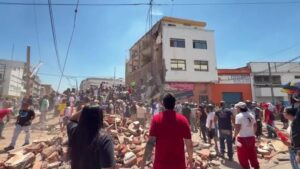
Colombia: The most powerful earthquake to strike Colombia this century has left a trail of devastation across its western coffee region, killing at least 254 people and leaving nearly 3,900 missing, authorities confirmed Tuesday. The 7.4-magnitude quake struck at 7:34 a.m. local time on Monday near San José del Palmar in Chocó.
According to the US Geological Survey, the tremor originated at a depth of about 100 kilometres and was felt by an estimated 10.5 million people across Colombia and in neighbouring Ecuador and Panama. The quake has been described as the deadliest to hit the country in decades, reducing apartment blocks, schools and homes to rubble.
Municipal reports on Tuesday gave a clear picture of the worst-hit zones. Pereira, the capital of Risaralda and the heart of Colombia’s Arabica coffee belt, reported 101 deaths, while Cali, the nation’s third-largest city located about 150 miles south of the epicentre, reported 95 deaths and over 800 injured.
Chocó, the sparsely populated and impoverished province closest to the epicentre, reported at least 12 deaths. Rescue teams said many Indigenous communities in the forested Pacific region remain cut off due to landslides, collapsed roads, and loss of electricity and communications.
The number of missing has now surpassed the confirmed dead, raising fears of a sharp rise in the toll. The citizen platform Colombia Te Busca, which was earlier used during the June twin quakes in Venezuela, now lists nearly 3,900 people as unaccounted for. Official figures also place the injured at over 2,600 and damaged homes at nearly 5,000.
Rescue operations have become Colombia’s largest disaster response in years. Police, soldiers, firefighters and civilian volunteers have been working through two nights with cranes, excavators, sniffer dogs and bare hands, forming human chains to clear debris and repeatedly calling for silence to listen for cries from under the rubble.
Amid the devastation, rescue teams reported extraordinary survivals. In southern Cali, a young mother and her six-month-old baby were pulled alive from the wreckage of a collapsed five-storey building with a rooftop swimming pool. Rescuers at the same site said they had detected signs of life from an elderly couple and their grandson.
The catastrophe is the first major crisis for President Abelardo de la Espriella, who was inaugurated only on Friday, August 8. He declared a state of disaster and then a national economic emergency, a constitutional measure that grants him temporary powers to issue tax and spending decrees without congressional approval.
From Chocó and later from Pereira, the President announced immediate relief measures, including temporary rental subsidies and emergency cash aid for more than 1,400 affected families. He said the government’s full capacity is deployed to protect lives and deliver aid to every area that needs it.
The economic impact is already visible. The National Coffee Federation said field teams are assessing damage to farms and rural infrastructure as coffee exports have been largely halted due to port closures and blocked highways. With Colombia being the world’s second-largest producer of premium Arabica, futures in New York whipsawed. International aid is scaling up, with the United States announcing $15.5 million in emergency assistance and the EU activating its Copernicus satellite service.